
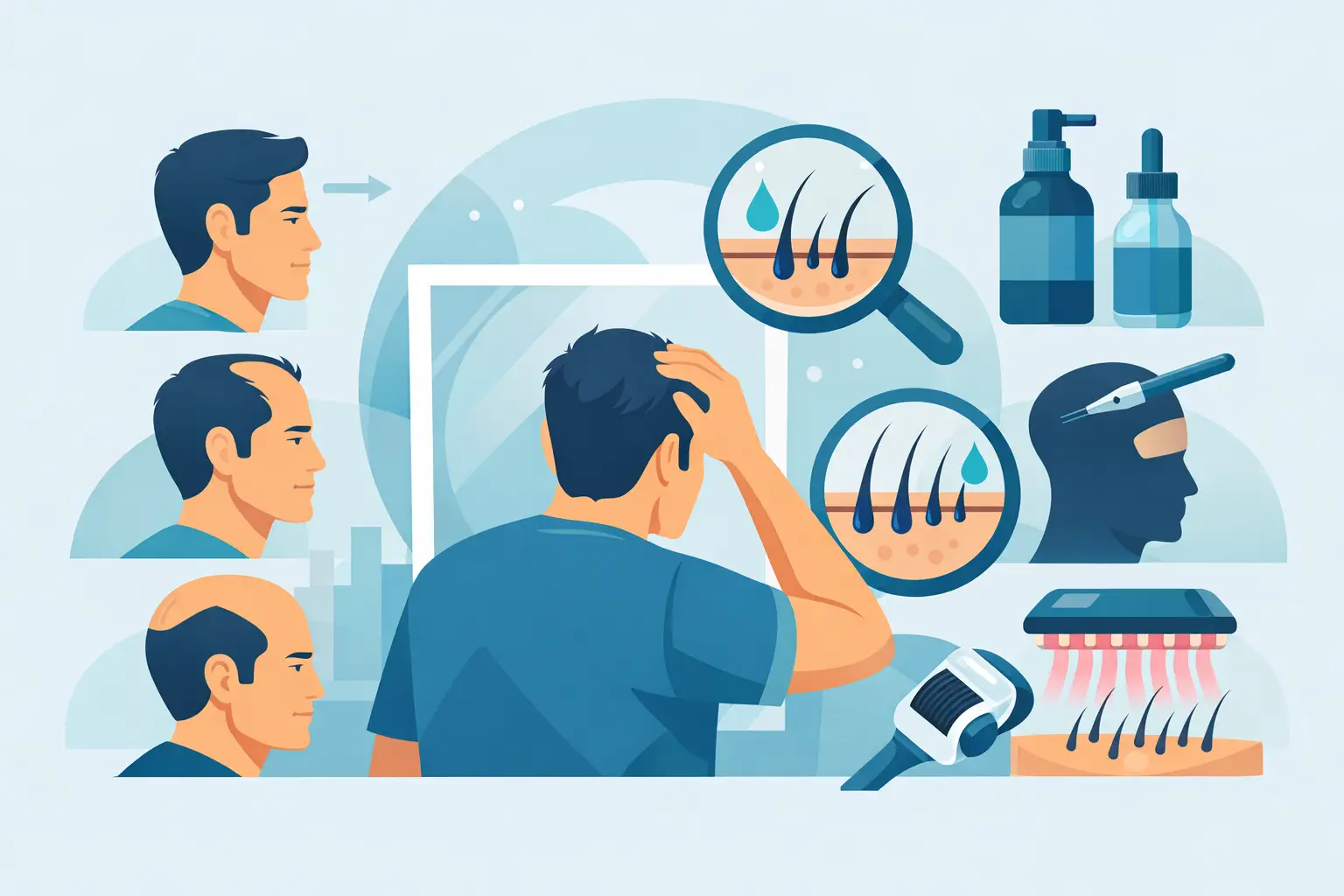
A receding hairline can look minor in the mirror yet feel like a major decision point. The right response is rarely the most aggressive treatment available. This Norwood scale treatment guide helps you match the degree and pattern of male-pattern hair loss with realistic options, including medication, hair transplant surgery, and scalp micropigmentation.
The Norwood scale is useful because it gives you a shared language for discussing hair loss with a qualified specialist. It is not a diagnosis, a prediction of your future, or a score that determines your confidence. Your age, family history, rate of shedding, donor-hair quality, medical history, and styling preferences all matter just as much.
What the Norwood scale measures
The Norwood scale, also called the Hamilton-Norwood scale, describes common patterns of androgenetic alopecia in men. It generally begins with subtle temple recession and can progress to a more pronounced M-shaped hairline, thinning at the crown, and eventually extensive hair loss across the top of the scalp.
Stages I through VII are broad reference points. Some men mainly lose hair at the temples, while others first notice a thinning crown. There are also diffuse patterns where hair becomes less dense across the scalp without following a clean, textbook Norwood shape. That is why a careful assessment matters more than assigning yourself a stage from one photo.
Hair loss can also be caused or worsened by conditions other than male-pattern baldness, including alopecia areata, scalp inflammation, nutritional deficiencies, thyroid concerns, and temporary shedding after illness or stress. Sudden patchy loss, scalp pain, redness, or rapid shedding deserves medical evaluation before pursuing a cosmetic solution.
Norwood scale treatment guide: options by stage
Norwood I-II: Preserve what you have
At these early stages, the hairline may be maturing or beginning to recede at the temples. The central forelock and crown are usually strong, and the goal is often preservation rather than a dramatic restoration.
A consultation with a dermatologist or experienced hair-loss physician can help confirm whether active androgenetic alopecia is present. Medications such as topical minoxidil and prescription finasteride may slow progression for appropriate candidates. Minoxidil requires consistent ongoing use, and results vary. Finasteride can be effective for some men but has potential side effects and should be discussed honestly with a prescribing clinician.
Hair transplant surgery may be an option for stable, well-defined recession, but it is often wise to avoid lowering a youthful hairline too aggressively. A transplant uses a limited donor supply. Planning for future loss is more valuable than chasing the hairline you had at 18.
Scalp micropigmentation can also work well at this stage when the concern is a slight lack of density at the temples or a hairline that needs subtle visual reinforcement. Rather than creating new hair, SMP uses layered pigment impressions to reduce contrast between scalp and existing follicles. The best work should look understated, especially at close range.
Norwood III-IV: Address the hairline and crown together
At Norwood III, recession is clearer, and a III Vertex pattern includes noticeable crown thinning. Norwood IV commonly combines deeper temple recession with a larger thin area at the crown, separated from the front by a bridge of hair.
This is often the stage where people consider a transplant, but the decision should start with donor assessment and loss stabilization. If the crown is thinning quickly, placing every available graft into the frontal hairline may create an unbalanced result later. Medication may still have a role in protecting existing miniaturizing hair, even if surgery is planned.
For candidates with good donor density, a carefully designed transplant can rebuild the frontal frame and add coverage where it will make the most visual difference. Full density across a large crown is not always realistic, particularly when future loss remains likely.
SMP is valuable here as a standalone choice for people who prefer a closely shaved look, or as a complement to surgery. It can make transplanted hair appear denser, soften the contrast in a thinning crown, and create the appearance of a fuller buzz cut without requiring additional grafts. Many people know this treatment informally as a hair tattoo, but quality SMP is more specialized than conventional tattooing. Pigment depth, dot size, color selection, and hairline design are critical to a natural result.
Norwood V-VI: Plan around coverage, not perfection
At these stages, the band of hair separating the front from the crown has narrowed or disappeared. There may still be healthy donor hair at the sides and back, but the area needing coverage is substantial.
A transplant may be possible, but expectations need to be precise. The available grafts must cover a large surface area, so the result often prioritizes a natural frontal hairline and the illusion of density over thick coverage everywhere. Some patients accept this trade-off happily. Others decide surgery cannot deliver the density they want from their donor supply.
SMP is particularly compelling for Norwood V and VI hair loss. With a shaved or very short hairstyle, it can create a consistent, well-framed appearance that does not depend on donor availability. It can also camouflage scars from previous FUT or FUE transplant procedures. For people with longer remaining side hair, the practitioner should evaluate whether the intended haircut and contrast level will remain believable as hair changes over time.
Norwood VII: Create a deliberate shaved-head look
Norwood VII involves extensive loss across the top of the scalp, with a horseshoe-shaped band of remaining hair. Donor limitations make high-density transplant outcomes difficult for many people at this stage, although individual assessments differ.
SMP is often the most predictable cosmetic option for a clean, closely shaved appearance. A skilled artist can create a conservative hairline, varied density, and a gradual blend into the remaining side and back hair. The goal is not to imitate thick long hair. It is to make a shaved look appear intentional, balanced, and age-appropriate.
How to choose between medication, transplant, and SMP
The best treatment is the one that fits both your hair pattern and the life you want to live. Medication can be a sensible foundation when you still have miniaturizing hair worth preserving. It involves ongoing commitment and medical guidance. It does not restore every lost follicle, and it may not suit everyone.
Hair transplantation can move living hair into areas of loss, which makes it the only option in this group that grows. Yet it is surgery, results take time, and donor hair is finite. A strong clinic will discuss graft allocation, future progression, medication strategy, scarring, and the possibility of more than one procedure before presenting a plan.
SMP does not stop hair loss or grow hair, but it can change how hair loss reads visually with remarkable efficiency. It is also flexible: some clients use it after a transplant to increase the look of density, while others choose it instead of surgery. It requires several initial sessions and occasional refreshes as pigment gradually softens. For people who do not want daily medication or surgical recovery, that maintenance trade-off can feel manageable.
Natural approaches can support scalp and general health, particularly when they improve nutrition, stress management, sleep, or hair-care habits. But they should not be marketed as replacements for evidence-based treatments when androgenetic alopecia is progressing. If a product promises to reverse advanced baldness quickly, approach it with caution.
Questions to ask at your consultation
A useful consultation should leave you better informed, not pressured. Ask what pattern of loss you have, whether your hair is likely still progressing, and what treatment goal is realistic for your donor supply and age. If you are considering SMP, ask to see healed results in different lighting, not only freshly completed photos.
For a transplant, ask how the proposed hairline will age, how many grafts are available for future work, and who performs each part of the procedure. For medication, ask about expected benefits, possible side effects, monitoring, and what happens if you discontinue treatment. Clear answers help you make informed decisions rather than committing to a plan based on anxiety.
Thailand can be an attractive option for readers comparing hair restoration care internationally, but travel should never replace due diligence. Confirm the credentials of the medical team, understand aftercare requirements, and allow enough time in your schedule for reviews or early recovery if needed.
Your Norwood stage is a starting point, not a verdict. Whether your next step is preserving existing hair, pursuing surgery, or choosing a precise SMP solution, a plan that respects your long-term pattern can help you feel more in control each time you look in the mirror.
ใส่ความเห็น