
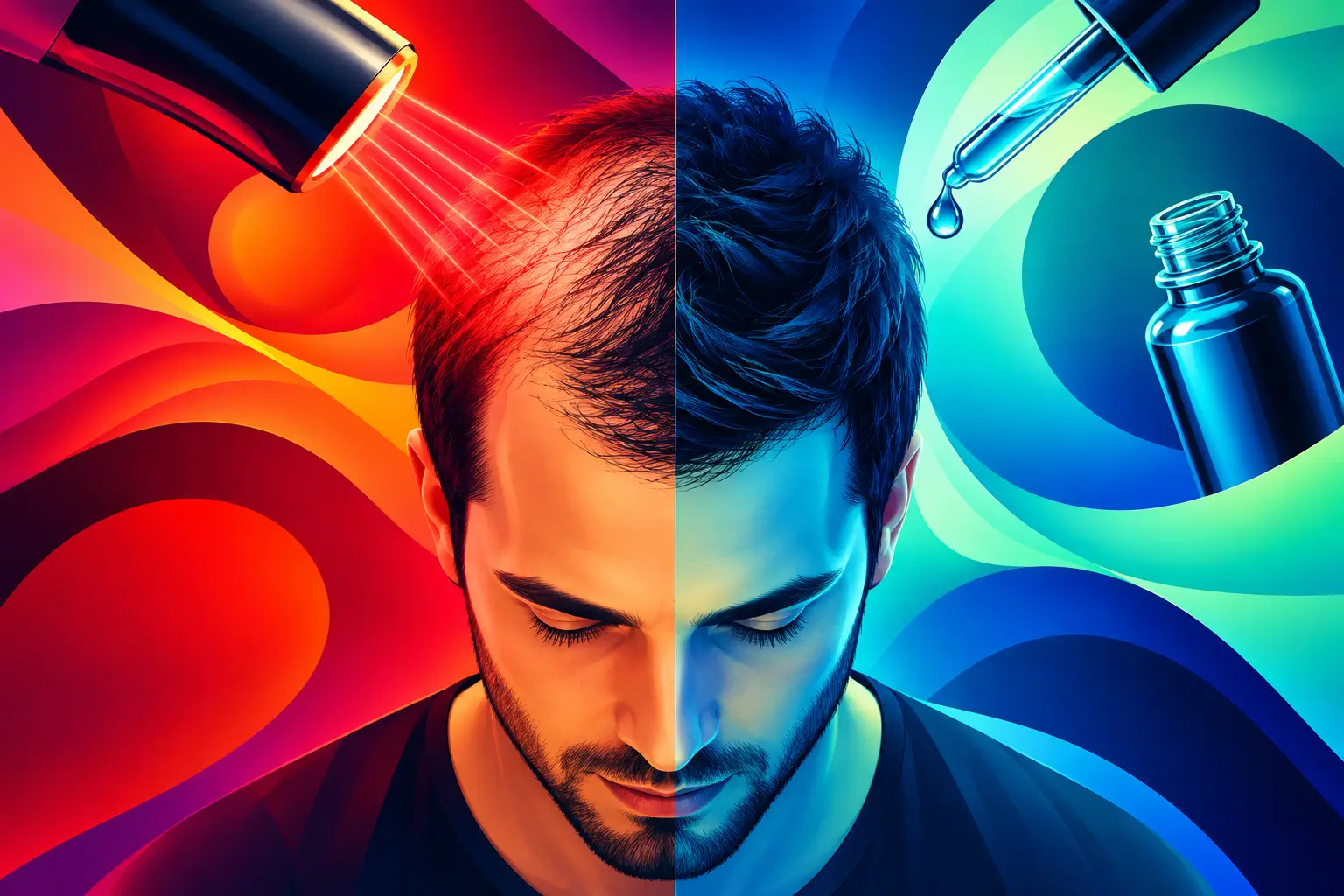
A thinning hairline rarely feels like a purely clinical issue. It can change how comfortable you feel under bright lights, in photos, or when styling your hair each morning. When comparing laser therapy versus minoxidil, the practical question is not simply which treatment is better. It is which option fits your type of hair loss, daily routine, budget, and expectations for visible change.
Both approaches are non-surgical and commonly used for pattern hair loss. They work in very different ways, require patience, and may be more effective when started while follicles are still producing thinner, finer hairs. Neither can reliably restore a fully bald area to its former density. That distinction helps you make an informed decision before investing months of time and money.
Laser Therapy Versus Minoxidil: The Core Difference
Minoxidil is a topical medication, usually applied as a liquid or foam to the scalp. It is used to support the growth phase of the hair cycle and can help some people maintain existing hair or improve the appearance of density over time. In the United States, topical minoxidil is available over the counter in certain strengths, though a dermatologist can help determine whether it is appropriate for you.
Low-level laser therapy, often called LLLT or red-light laser therapy, uses specific wavelengths of light delivered through a helmet, cap, comb, or clinic-based device. The goal is to stimulate activity around the hair follicle without damaging the scalp. It is painless and does not involve injections, surgery, or medication applied to the skin.
The central trade-off is straightforward: minoxidil is generally less expensive to start but asks for consistent ongoing application. Laser devices can involve a larger upfront cost, while treatment sessions are usually easier to fit into the week once a routine is established. Results from either option depend heavily on consistency.
How Effective Is Each Option?
For many people with early to moderate androgenetic alopecia, minoxidil has the longer clinical track record. It can slow further thinning and encourage visible thickening in responsive follicles. Results vary by individual, and the most realistic outcome is often improved coverage rather than dramatic regrowth. People with recent thinning tend to have more potential than those with smooth, long-standing bald areas.
Laser therapy also has evidence supporting improved hair density or thickness for some people with pattern hair loss. However, devices vary widely in design, power, session schedule, and quality. A cap that makes broad claims without clear specifications or professional guidance should be approached carefully. The best device is not necessarily the one with the most aggressive marketing. It is one that is suitable for your condition and that you will genuinely use as directed.
Neither treatment creates new hair follicles. If follicles have been inactive for years, medication and light therapy may offer little visible regrowth. In that situation, a hair transplant may be considered if donor hair is sufficient, while scalp micropigmentation can create the appearance of fuller density or a closely shaved hairline without requiring regrowth.
Timing Matters More Than Most People Expect
Hair growth moves slowly. A person may notice temporary shedding when beginning minoxidil, which can be unsettling but does not automatically mean the treatment is failing. This can occur as hairs transition through the growth cycle. Persistent or severe shedding, scalp symptoms, or any concerning reaction should be discussed with a medical professional.
With either approach, it often takes three to six months to judge early change, and closer to 12 months to assess the fuller response. Taking standardized photos before treatment and at monthly intervals can be more useful than relying on memory. Use the same lighting, angle, hair length, and styling each time.
Safety, Side Effects, and Everyday Convenience
Minoxidil is convenient in the sense that it can be purchased without a procedure, but it is not effortless. Most formulations are intended for regular use, often once or twice daily depending on the product and clinical advice. Skipping applications frequently can reduce the benefit. If treatment is stopped, hair that depended on minoxidil support may gradually return to its prior pattern of thinning.
Common concerns include scalp irritation, itching, flaking, or residue in the hair. Foam products may be more comfortable for some users, especially those sensitive to ingredients in certain liquid formulations. Unwanted facial hair can occur if product transfers beyond the scalp. Although uncommon with topical use, symptoms such as chest pain, rapid heartbeat, dizziness, swelling, or shortness of breath require prompt medical attention.
Laser therapy is generally well tolerated. A session may take around 10 to 30 minutes, depending on the device and protocol. Some users report mild warmth, temporary scalp sensitivity, or headache, but significant side effects are not typical when a suitable device is used correctly. Still, red-light treatment is not a universal fit. Anyone with a photosensitivity condition, a history of light-triggered reactions, or medications that increase sensitivity to light should seek medical guidance first.
Convenience is personal. A person who travels frequently may prefer a compact laser cap over carrying and applying topical product. Someone who wants the lowest upfront financial commitment may find minoxidil easier to begin. The ideal plan is rarely the theoretically perfect one. It is the plan you can follow consistently for a year.
Cost: Upfront Price Versus Long-Term Commitment
Minoxidil usually has a lower entry cost, especially with generic products. But it is a recurring purchase, potentially for as long as you want to retain the benefit. Add specialized shampoos, dermatologist appointments, or complementary treatments, and the long-term total can grow.
Laser therapy devices often cost more upfront. Clinic sessions may spread the cost over time, while an at-home device puts the investment at the beginning. Before buying, ask whether the price includes a warranty, device support, and clear instructions. It is also reasonable to ask a clinic how it assesses progress rather than relying on promotional before-and-after images alone.
For readers considering treatment in Thailand, compare more than the headline price. Look at provider qualifications, follow-up access, device quality, transparent treatment protocols, and whether the recommendation is based on an assessment of your hair loss rather than a one-size-fits-all package.
Can You Use Laser Therapy and Minoxidil Together?
Often, yes. Some people use both because the treatments have different mechanisms and can complement one another. Combining them may be reasonable for early thinning when a clinician agrees that there are no individual contraindications. It also means managing two routines, two costs, and a higher chance that one part of the plan will be abandoned after the first few busy weeks.
A combination approach should be intentional. Begin with baseline photographs, decide how you will track adherence, and set a realistic review point. If irritation from minoxidil makes you avoid using it, a laser routine alone may be more sustainable. If a laser device sits unused in a closet, a simple topical plan may be the more effective choice in real life.
When Neither Is the Complete Answer
Diffuse thinning can be linked to stress, nutritional deficiencies, thyroid disorders, recent illness, hormonal changes, or certain medications. Patchy hair loss, sudden shedding, scalp pain, or inflammation deserves medical evaluation rather than self-treatment alone. Treating the underlying cause may matter more than choosing a laser cap or topical foam.
For advanced recession or baldness, treatment goals may shift from regrowth to appearance management. A transplant can redistribute existing donor hair but is still limited by donor supply and often benefits from long-term hair-loss management. Scalp micropigmentation, sometimes searched as hair tattoos, uses carefully placed pigment impressions to reduce contrast between hair and scalp. It can make thinning hair look denser, camouflage transplant scars, or create a natural shaved-head look. It does not grow hair, but for the right candidate, it can restore a sense of control quickly.
How to Choose With More Confidence
Start by identifying what you want most: to slow loss, improve density, preserve a transplant result, avoid daily medication, or change the visual impact of thinning. Then consider your pattern of loss, medical history, scalp sensitivity, and willingness to maintain treatment long term.
A qualified dermatologist or hair restoration specialist can help distinguish common pattern loss from conditions that need different care. Be wary of anyone promising permanent regrowth, guaranteed density, or a universal solution. Hair restoration is more credible when it includes clear limits as well as potential benefits.
Your hair-loss plan does not have to look like anyone else’s. Whether you choose minoxidil, laser therapy, a combined approach, or an appearance-focused option such as SMP, the most useful next step is one that feels realistic enough to keep – and supportive enough to help you regain confidence on your own terms.
Leave a Reply