
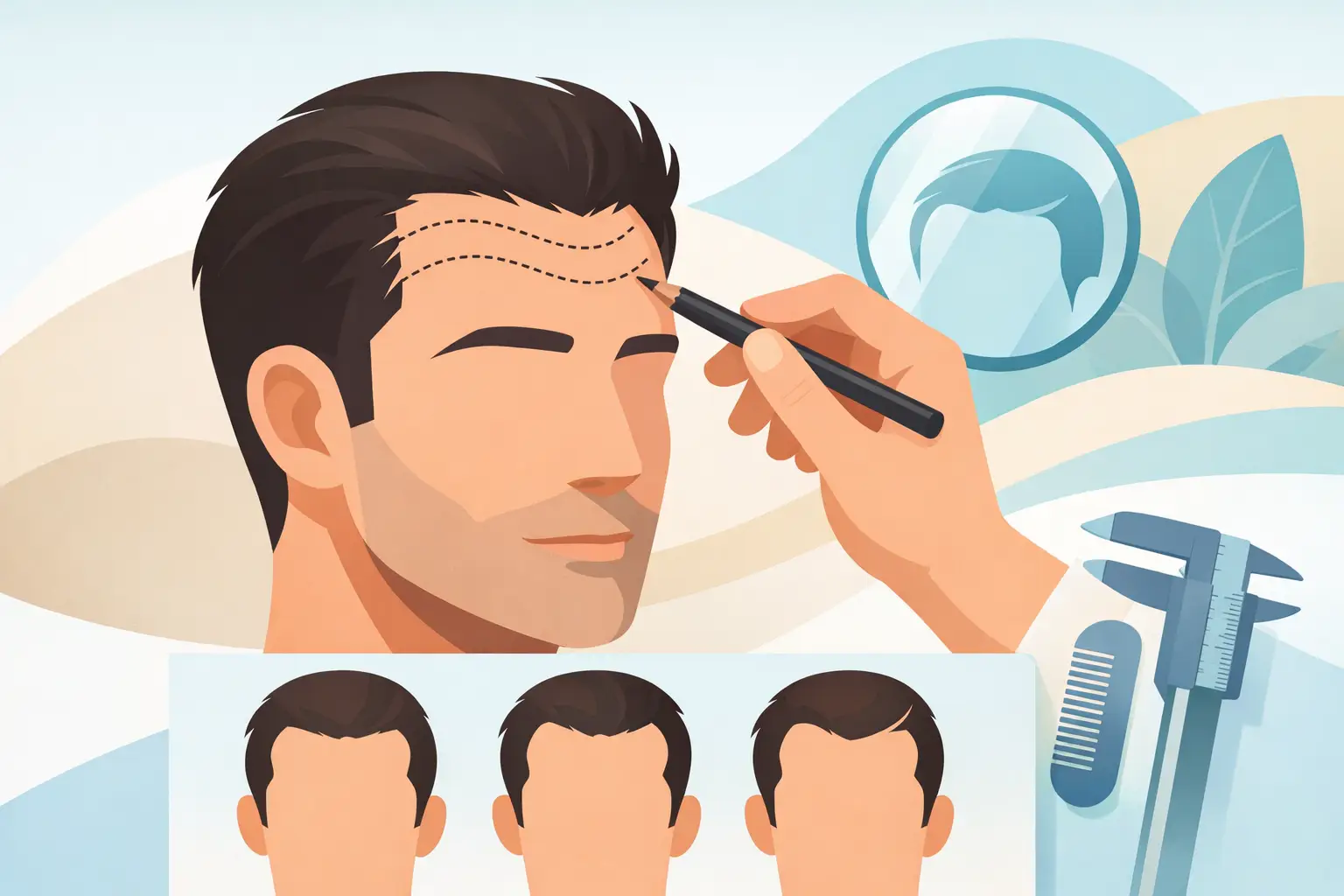
A hairline can change the way a face is read in seconds. It affects perceived age, facial balance, and, for many people, the confidence to step outside without thinking about hair loss. That is why hairline design should never be treated as a quick line drawn across the forehead. Whether you are considering scalp micropigmentation (SMP), a hair transplant, or a combination approach, the best result begins with a shape that looks like it belongs to you.
A strong design does not usually announce itself. It accounts for your facial proportions, existing hair pattern, age, skin tone, and the likelihood that hair loss may continue. The goal is not to recreate a teenage hairline at all costs. It is to create a believable, sustainable frame for the face that feels right now and still makes sense years from now.
What Hairline Design Really Means
Hairline design is the process of planning the position, shape, density, and transition of the frontal hairline. It is a central part of both SMP and transplant planning, but the techniques create that design in different ways.
With a transplant, the surgeon uses donor hair to build the frontal zone and may add density behind it. With SMP, a practitioner layers tiny pigment impressions to create the appearance of closely shaved follicles. This is why people sometimes call SMP “hair tattoos,” although the comparison is incomplete. SMP uses specialized pigments, shallow placement, and a stippling method designed to imitate a natural follicle pattern rather than produce solid tattoo artwork.
In either treatment, the design determines whether the result looks balanced or looks artificially placed. A technically competent procedure can still disappoint if the hairline sits too low, appears too straight, or does not match the person’s natural features.
A Natural Hairline Is Not Perfectly Symmetrical
Many people arrive at a consultation with a clear visual reference: a straight, sharp line from an old photo, a celebrity image, or a digitally altered preview. Those references can help communicate preferences, but they should not be copied without context.
Natural hairlines have variation. One side may sit slightly higher than the other. The leading edge is typically softer than the denser area behind it. There may be small irregularities, subtle recession at the temples, and a gradual transition into the frontal scalp. These details are not flaws. They are often what prevent an SMP hairline or transplant from looking stamped on.
For SMP, the practitioner may create a feathered front edge with lighter, more dispersed impressions before building density farther back. For a transplant, a surgeon may use finer single-hair grafts at the front and reserve multi-hair grafts for density behind the hairline. The shared principle is restraint: a natural result uses controlled variation, not a ruler-straight border.
The face matters more than a trend
A hairline should support the proportions already present in your face. A lower placement can shorten a long forehead, while too low a placement may make the face appear crowded or create an unnatural contrast as you age. Temple shape also matters. A softly receded, mature pattern can look more convincing than aggressively squared corners, especially for someone with established hair loss.
The right design varies by person. Someone who keeps a shaved head may want a defined but age-appropriate SMP hairline. Someone with diffuse thinning may need a softer design that blends into existing hair. A person with alopecia may have different priorities again, particularly around whether the appearance should resemble a very close buzz cut or a more subtle density effect.
Why Age and Future Hair Loss Belong in the Plan
The most common hairline design mistake is planning only for the mirror today. Androgenetic hair loss can progress, even after a transplant, and medication may slow further loss for some people but cannot guarantee a fixed pattern. If a very low, juvenile hairline is created while the hair behind it continues to thin, the result can become disconnected.
This does not mean everyone should accept a high hairline. It means a specialist should explain the trade-off clearly. A conservative design often preserves more options if you need density work, a second transplant, or additional SMP later. It also tends to age more naturally.
Future planning is particularly important for younger patients. A hairline that feels conservative at 28 may feel reassuring at 40. Donor hair is limited in transplant surgery, and pigment placement should be chosen with the possibility of future adjustments in mind. Thoughtful planning can protect both your appearance and your treatment flexibility.
SMP Hairline Design Versus Transplant Design
SMP and transplants can both create a stronger-looking hairline, but they are not interchangeable. The best option depends on your hair loss pattern, donor supply, desired hairstyle, budget, medical suitability, and maintenance expectations.
SMP is often a strong fit for people who prefer a very short haircut, have extensive baldness, want to camouflage scalp contrast, or need the appearance of added density after a transplant. It can create a crisp visual frame without surgery, but it does not grow hair, add physical texture, or allow long hairstyles. It generally requires several sessions, followed by occasional refreshes as pigment gradually softens.
A transplant creates actual growing hair and can suit people who want styling flexibility. However, it requires adequate donor hair, surgical recovery, and realistic expectations about graft survival and density. A transplant hairline also needs careful design because grafts are permanent. In some cases, combining a conservative transplant hairline with SMP behind it provides fuller visual density than either approach alone.
Neither option is automatically better. A good consultation helps you understand which trade-offs you are comfortable making before committing to a design.
What to Discuss Before Approving a Design
A specialist should not simply ask, “How low do you want it?” The discussion should cover your current hair loss, family history, preferred haircut length, daily styling habits, and whether you use hair-loss medication or have had previous restoration work. If you have visible scarring from a past procedure, that should also be assessed because SMP may be used differently over scar tissue than on untouched scalp.
Bring photos from several periods of your life if available. Earlier photos can reveal your original hairline character, including temple shape and asymmetry. They are useful reference points, but they are not always the exact target. The final plan should reflect your current age, future hair-loss risk, and practical treatment path.
Ask the provider to mark the proposed hairline while you are sitting upright and looking directly ahead. Review it from the front and side, not only in a close-up mirror. A design can look appealing at forehead level but feel too low or too sharp when viewed in full facial proportion.
It is also reasonable to ask how the provider handles changes. For SMP, ask how they build the front edge gradually and what fading or future refreshes may involve. For transplant surgery, ask how grafts are allocated, how donor limitations affect the plan, and what happens if surrounding native hair continues to thin.
Signs a Hairline May Be Overdesigned
A bolder hairline is not always a bad choice, but it deserves extra scrutiny when it is markedly lower than your natural adult pattern, unusually straight, or sharply squared at both temples. These features may photograph well immediately after treatment while becoming harder to maintain convincingly over time.
Be cautious if a provider promises a perfect result without discussing your age, progression of hair loss, skin characteristics, or maintenance. Confidence comes from understanding the plan, not from being rushed into the most dramatic visual change. A responsible specialist will welcome questions and explain why a particular shape is recommended.
The Value of a Gradual Approach
For SMP, a gradual build is often one of the clearest signs of careful work. Early sessions can establish a soft framework, with later sessions adding depth after the practitioner sees how your skin retains pigment and how the design reads in normal light. This approach gives you room to assess the result rather than committing to excessive darkness or a harsh front edge on day one.
The same mindset applies to surgical planning. A well-designed transplant does not have to pursue maximum density in a single stage. Preserving donor resources and building a hairline that blends with future treatment options may produce a more dependable long-term outcome.
Hair loss can feel deeply personal, but deciding on a treatment does not have to feel overwhelming. Take time to compare the visual goals and limitations of SMP, transplant surgery, medication, and combined approaches. The most successful hairline is rarely the lowest or boldest one. It is the one that looks credible in everyday life, respects your future options, and lets you spend less time thinking about what is missing.
Leave a Reply