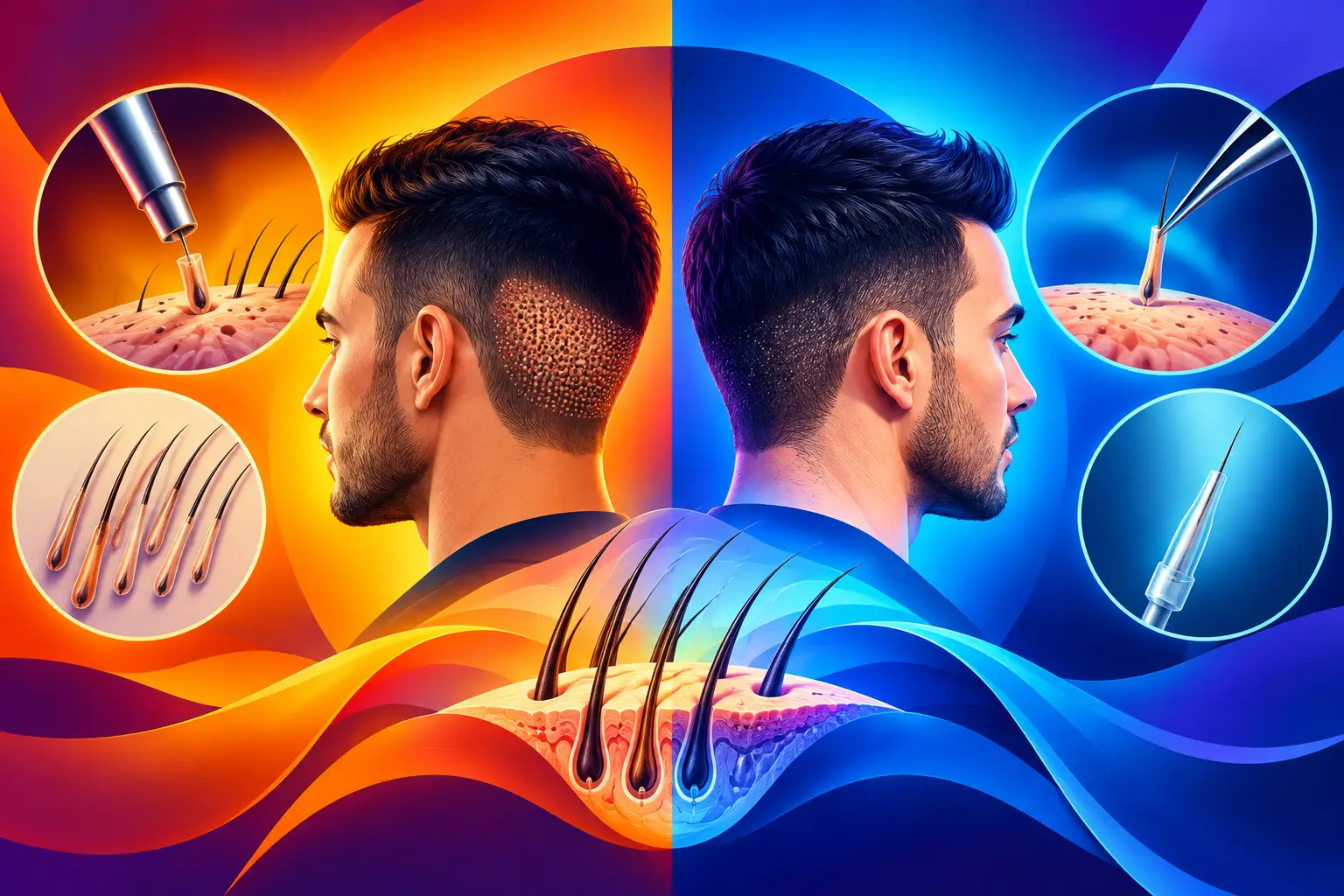
A transplant consultation can feel confusing when two procedures are presented as completely different answers to hair loss. In the FUE versus DHI transplantation discussion, the most useful starting point is simple: both usually harvest individual follicular units from the donor area. The meaningful differences are mainly in how those grafts are implanted, who performs each stage, and whether the clinic’s plan suits your hair loss pattern, donor supply, and expectations.
For people considering treatment in Thailand or comparing options from abroad, the name of the technique matters less than the quality of diagnosis, graft handling, hairline design, and long-term planning. A natural-looking result is not created by an implanter pen alone.
What FUE and DHI Actually Mean
Follicular unit extraction, or FUE, is a method of removing naturally occurring groups of one to four hairs from the back and sides of the scalp. A surgeon or trained extraction team uses a small punch to remove each graft. The grafts are then stored under controlled conditions before placement into tiny recipient sites made in the thinning area.
DHI stands for direct hair implantation. In most modern clinics, grafts are also extracted individually using FUE-style techniques. The distinction is in placement: grafts are loaded into a Choi implanter pen or similar device, which creates the recipient opening and inserts the graft in one action.
That is why DHI is often better understood as a graft implantation approach rather than a wholly separate transplant method. Marketing can make the choice sound more dramatic than it is. Both procedures depend on the same biological reality: transplanted follicles must be healthy, handled gently, and placed into a scalp with adequate blood supply.
FUE versus DHI Transplantation: The Practical Differences
With conventional FUE placement, the surgeon typically makes recipient channels first. Those channels determine the angle, direction, depth, and distribution of the new hair. Technicians may then place grafts with forceps or an implantation tool, depending on local regulations and the clinic’s protocol.
With DHI, the implanter pen lets the person placing the graft control site creation and implantation together. This can be useful in small areas where precise direction matters, such as a frontal hairline, temple points, or work between existing hairs. It may also reduce the amount of time a graft is outside the body when the workflow is well organized.
Neither point automatically makes DHI superior. A highly skilled surgeon can create exceptionally natural recipient sites with standard FUE, while poorly controlled use of an implanter can still damage grafts, create an unnatural angle, or crowd follicles too closely. The team, not the label, determines whether a technique is being used well.
There can also be practical differences in shaving. Some DHI clinics promote partial-shave or unshaven procedures because the pen can help work around longer existing hair. FUE can also be performed with limited shaving in selected cases. The trade-off is that unshaven work often takes longer, can cost more, and may limit the number of grafts safely transplanted in one session.
Which Option Is Better for Different Goals?
DHI may be worth discussing if you have early thinning and want to add density between existing hairs, especially in a defined frontal area. The controlled placement process can be helpful when preserving and working around native hair is a priority. It may also appeal to people who want a more discreet recovery from a smaller procedure.
FUE may be the more flexible choice when you need a larger graft count to rebuild a receding hairline, fill the mid-scalp, or address a crown with extensive thinning. Creating recipient sites separately can give an experienced surgeon a clear view of the overall pattern before placement begins. It is also widely available and often less expensive per graft.
However, candidacy is never determined by the name of the procedure alone. A person with advanced hair loss but limited donor density may need a conservative hairline and carefully staged treatment, whether the clinic offers FUE or DHI. Someone whose hair loss is still progressing may be advised to stabilize it with medical treatment before surgery. For diffuse thinning, the doctor must also assess whether the existing hairs are strong enough to tolerate implantation between them.
People with alopecia areata, active scalp inflammation, uncontrolled medical conditions, or unrealistic density goals may not be suitable candidates at that time. A responsible consultation should make room for these conversations rather than promising a fixed graft number before examining your scalp.
Results, Recovery, and What You Can Realistically Expect
FUE and DHI have similar healing timelines because both involve extraction and implantation. Tiny scabs in the recipient area usually shed within roughly 7 to 14 days when aftercare instructions are followed. The donor area generally heals as small dot-like wounds, though redness can last longer for some skin types.
Transplanted hair commonly sheds during the first few weeks. This is expected shock shedding of the hair shaft, not necessarily loss of the follicle. New growth may begin around three to four months, become more noticeable between six and nine months, and continue maturing for 12 months or longer. Crown results can take additional time.
The outcome also depends on characteristics that no device can change: your donor density, hair caliber, curl pattern, contrast between hair and scalp, and the extent of loss. Fine, straight hair on a high-contrast scalp may require more grafts to create visual coverage than coarse or curly hair. A clinic that discusses these limits honestly is helping you make an informed decision.
Cost Should Reflect More Than the Package Name
DHI is often priced higher than FUE because of specialized pens, a slower implantation workflow, and the way the procedure is positioned. But a higher price does not confirm better survival rates or a more natural appearance. Conversely, a low per-graft offer can conceal rushed sessions, inexperienced staff, or unclear responsibility for surgical steps.
When comparing clinics, ask what the quote includes: the surgeon’s involvement, graft count, anesthesia, medication, follow-up care, and any added charge for unshaven work. Ask who extracts grafts, creates recipient sites, and implants them. These questions are especially useful for medical travelers, who need clarity before arranging flights and recovery time in Thailand.
Do not choose purely by a promised graft total. Overharvesting can leave the donor area visibly thin and reduce options for the future. A thoughtful plan protects donor reserves because hair loss can continue after surgery.
The Role of SMP in a Transplant Plan
A hair transplant moves living follicles, but it cannot always produce the density of an untouched scalp. This is where scalp micropigmentation, sometimes called a hair tattoo, can be a valuable complementary option. SMP uses carefully placed pigment impressions to reduce scalp-to-hair contrast, making transplanted or native hair appear fuller without taking additional grafts from the donor area.
For a closely shaved style, SMP can create the appearance of a fuller buzz cut without transplant surgery. For transplant patients, it can help camouflage a linear or dot-like scar, soften the appearance of a thin donor zone, or add visual density after growth has matured. It does not grow hair and it is not a replacement for surgery when you want length and movement, but it can make a limited donor supply work harder visually.
Medication, styling changes, and SMP may also be more appropriate than surgery for some people with early loss or unstable patterns. The best path is the one that protects both your appearance now and your choices later.
Questions to Ask Before You Commit
Bring photographs of your hair before thinning, along with examples of hairlines you like. Then ask the clinic how it estimates your future pattern of loss, how many grafts can be safely taken, and why it recommends FUE or DHI for your particular scalp. Request clear, consistent before-and-after images taken at similar angles, lighting, and hair length.
It is also reasonable to ask about complication management, revision policies, and the credentials of every person involved in the procedure. A good provider will not pressure you to decide quickly. They will explain the limits of donor hair, the possibility of needing future treatment, and the maintenance needed to protect your existing hair.
The right choice between FUE and DHI is rarely about choosing the newest-sounding method. It is about finding a careful medical team and a realistic plan that respects your donor supply, your lifestyle, and the confidence you want to regain.
Leave a Reply